Showing posts with label butterfly. Show all posts

Tuesday, July 21, 2015

Pine White Butterfly - Current Wildlife Spectacle

There seems to be a boom right now in the Pine White (Neophasia menapia) Bitterroot Valley population. I got a second hand report of clouds of white butterflies floating about the crown of Ponderosa Pine at the Bass Creek NRA campground. I saw many on a weekend hike at Blodgett Canyon Overlook. According to Pyle (2002), this species of White (Pieridae family) is unusual for its preference of conifer as larval host and the population booms (outside of this, common most years).

Who hasn't watched the nature specials on television highlighting the wildebeest migration in Africa. Or read of the extinct Passenger Pigeon migration numbers. Though this event is not on equal footing, it is surreal, poetic and memorable. We wildlife watchers wish to be there for these displays of life. They are special to see and be part of. Check your flower garden, maybe your plantings have contributed to an increased number of locally common butterfly...that is just as exciting!

Below is a photo from August 2011 at Bass Creek NRA illustrating the incredible spectacle of white butterflies there that year:

Below are close-ups of a female (creamy with reddish coloring on trailing wing edges) and a male (white with thin black lines):
Female Pine White

Male Pine White

Friday, January 16, 2015

Lighting and Butterfly Identification

Many butterflies are only identified by the underwing color and pattern. Hopefully the butterfly cooperates and shows the wing surface necessary for identification. Fortunately, Commas or Anglewings can be identified either by the upper or underwing. They are separated easily from other butterfly species by the whitish silver "comma" mark on the underwing. There are four species I regularly encounter in western Montana: Satyr, Green, Oreas and Hoary. The underwing coloration, in general and subject to variation, of each respectively is: buffy brown, dark brown, blackish brown and grey.

The position of the wing in relation to the sun is critical for "true coloration", ergo proper identification. Remember coloration of butterflies (and birds too) observed may or is determined by light striking actual colored pigment or by absorption/reflection by the wing scales. And scales cover a transparent membrane. The three photos below illustrate wing coloration of a Hoary Comma (Polygonia gracilis) nectaring on Rabbitbrush under different light aspects (same day/same place).

Note the reddish brown underwing coloration of the most immediate photo below. For sure an artifact of backlighting, the wings are open enough for direct light to strike the upperwing. As a consequence the orange color suffuses the underwing. The second photo below captures the butterfly with its wings partially open negating backlighting, but introducing a shading factor. The underwing is not getting direct lighting and is likely darker than it really is. The third photo reveals the true underwing color, grey...diagnostic for a Hoary Comma.

Again, lighting is very important for identification by sight or photograph. This situation crops up on a regular basis even when aware and compensation (keeping the sun to your back...if possible) is attempted. All is not lost because many less-than-ideal looks/photos will still have enough colors and features to id, if that is one of your goals. Study your field guides now...April/May is not far away to test your skills :-)

Wings Folded Open "Backlighting" Underwing

Wings Partially Open Shading Underwing

Wings Closed, Underwing Exposed to Direct Light

Tuesday, June 3, 2014

Positioned for Success...Working on Something Else

I bought 15 Blanketflower (Gaillardia aristata) after work and was planting them in the yard when a butterfly lit on last years spent flower closeby. Quickly noted the small size with smudgy brown underwing with multiple arrowhead markings. Wow, been trying to photograph Arrowhead Blue (Glaucopsyche piasus) for a while; photo I have is diagnostic, but out of focus for most part. Ran for the house, retrieved camera, sprinted back. Still there!!!  I took 50 photos, most at minimum focus distance with 70-300mm lens.

Sure enough, it was an Arrowhead Blue. The photo meant to replace was taken 2 years ago, almost to the date...June 3 (today) vs. June 4 (blog posting of event: http://goo.gl/Vq3ljw) a mere two hundred yards apart!!! Sure ignited my joy though a "small win" (read the Progress Principle by Teresa Amabile and Steven Kramer 2011). Have you had such an experience?

Arrowhead Blue

Tuesday, May 20, 2014

Mimic Plant Phenology...Become A Recurring Wildlife-Watching Phenomenon

I went outside after dinner, conditions were good (warm and sunny) for finding...butterflies. The hillside below our house is a grassland with interspersed conifers. The highlight is a large area of Arrowleaf Balsamroot (Balsamrhiza sagittata) flowering now. Sure enough, spied two butterflies that were pretty skittish: Boisduval Blue (Plebejus icarioides) and Clouded Sulphur (Colias philodice), photos below.

Success at finding wildlife can and is influenced by knowledge of phenology. Phenology defined: "The scientific study of cyclical biological events, such as flowering, breeding, and migration, in relation to climatic conditions. Phenological records of the dates on which seasonal phenomena occur provide important information on how climate change affects ecosystems over time" (The American Heritage® Science Dictionary Copyright © 2002. Published by Houghton Mifflin). So by knowing that flowers are important food sources for some butterfly species, one can narrow down butterfly searches to places that have flowers in bloom.

If you repeatedly use this strategy...well your behavior becomes a recurring phenomenon (a remarkable person!), though not dictated by climate :-) The bolded words are a positive meme, but they are really a call to action...get outside and wildlife watch even if for only 15-30 minutes a day. It's guarantee you will discover a world of beauty and wonder.

Arrowleaf Balsamroot

Boisduval Blue

Clouded Sulphur

Monday, April 14, 2014

2nd, 3rd, 4th Wildflower Species of 2014

First field trip today (Mondays are my day off and conditions were sunny and 60 F as a high) for wildflowers. A bit early in the season, been cool and not too conducive for plant development. But wasn't disappointed at Waterworks Hill in Missoula, a conservation easement/open space bond issue adopted by forward thinking community members. A steep aerobic climb and one is on the east/west ridgetop. Douglasia (Douglasia montana) was the target, several dozen plants were in bright pink flower (early season color beyond brown...wahoo!). Not only did I find them, but so did four or so Checkered White (Pontia protodice) butterfly (nice unexpected bonus for me). On the way back down captured a photos of Yellow Bell (Fritillaria pudica) and Few-flower Shootingstar (Dodecatheon pulchellum).
You folks that live back east should be able find Harbinger of Spring (Erigenia bulbosa) or perhaps Spring Beauty (Claytonia virginica) in flower. Take a walk in the wild spot of your neighborhood...development doesn't always get all the wild spots. Get your daily Vitamin D this way, the sunshine vitamin...a lack thereof may be linked to heart disease.

Douglasia and Checkered White

Few-flower Shootingstar

Yellow Bell

Sunday, March 16, 2014

Exploring and the 1st Butterflies for 2014

Sixty One degrees Fahrenheit and partly sunny today; first warm day (wahoo!!!) this spring. To celebrate I took a wildlife watching trip to Bass Creek NRA to find birds, butterflies, lichen, moss, wildflower (in no particular order though I strongly felt some butterflies could be on the wing). My objectives: a) to use my cameras and  b) be an explorer because " everything is interesting" (check out this great book, How To Be An Explorer of the World by Keri Smith).

Arrived to find much snow still on the ground (immediate photo below) in shaded areas, but south facing slopes had large patches of exposed ground. Advanced up the trail and found my special spot, yep where several trees have "sap wells" (2nd photo below) a magnet for early season leps. No sap and no butterflies (lone Steller's Jay [Cyanocitta stelleri "sheking" up a storm]), so I retreated to the sunny slopes near the trailhead. Within a couple of minutes spied two Mourning Cloak (Nymphalis antiopa) on "scat" (bottom photo). Great find for me, 15 days ahead of last years first-of-year sighings.  Working slope further flushed a Comma, likely a Green. Finished off my exploration with photos of 3 different mosses, may take quite a while to identify (rookie status).  It was great fun...try it for yourself :-) 
Bass Creek NRA trail in March, snow blanketing ground
Bass Creek NRA landscape

Early Season Food Source for Butterflies
Sap Wells
Mourning Cloak Utilizing Scat for Early Season Food/Minerals
Mourning Cloak on Scat

Sunday, July 7, 2013

Connecting the Wildlife Viewing Dots...What Should Be Obvious

It wasn't until yesterday that I connected the dots in finding Parnassian butterflies thanks to a Northwest Butterflies blog posting on the Gifford Pinchot NF. The author smartly included photos of the habitat visited...and there it was...steep, rocky road cuts. These areas typically are home to stonecrops (the sedum genus or succulent in general) which are the larval host plant for Parnassian butterflies. A mere fifteen minutes from my home is Blue Mountain (Lolo NF), which has windy steep road cuts in places (duh!!!!). So mid-afternoon I went on an adventure of discovery. Sure enough, as I emerged onto a south-facing straightaway I saw three white butterflies soaring Turkey Vulture-like low over the gravel road and vegetation. Quickly parked into the nearest pull-out and chased after the butterflies with camera in-hand. Never did get a "great" photo of the Rocky Mountain Parnassian (Parnassius smintheus), however did manage some diagnostic pics. As a bonus, found and photographed a White Bog Orchid (Platanthera sp.) and a Sinous Snaketail (Ophiogomphus occidentis) along ravine stream. Connect some dots today too :-)
Rocky Mountain Parnassian

Parnassian Habitat

White Bog Orchid

Sinous Snaketail


Saturday, July 6, 2013

Why So Few Green-Colored Butterflies in North America?

In a crude search of the Kaufman Field Guide to Butterflies of North America, I found only 18 species with green or 2.4% of all species. Green-colored butterflies are predominantly Hairstreaks, why is that? Below is a stunning Juniper Hairstreak (Callophrys gryneus) that I recently photographed (lifer). I did a Google Scholar search of the lepidopteria literature and could not find an answer to my question. Did come across Elements of Butterfly Wing Pattern by H.F. Hijhout which detailed that butterfly spots, stripes do not vary in positions across individuals, quite different than human fingerprints or zebra stripes and leopard spots. Hijhout states that butterfly spots/stripes are an "individuated"character that can be given a name and traced over the phylogenetic tree.
Juniper Hairstreak
Here's a couple of photos of the red/orange butterflies (can you identify to species?) coming to Sawmill creek (Sapphire Mountains of Stevensville, MT) to "mud"... find something great in your own neighborhood!


Friday, July 5, 2013

Wood-Nymph's...No Special Plantings Required

 Encountered two Wood-Nymph butterfly species, Common (Cercyonis pegala) and Small (Cercyonis oetus) while watering yard plantings early this morning. Both butterflies did not nectar on any of the flowers in bloom. Instead they simply rested on the ground (wood bark mulch) as is their behavior at times. They do nectar more than other related species in the Satyrinae subfamily, but also utilize rotting fruit, dung and mud. Grasses are the host plant for larval development. Identification is dependent on size, shape and location of eyespots on underside of front wing. Both are somewhat easy to find in western Montana (Common is distributed throughout the U.S.), though they are definitely not flashy in coloration. Adults are active during July and August so now would be a good time to check your own yard or neighborhood for these insects.
Common Wood-Nymph

Small Wood-Nymph

Monday, April 1, 2013

Exploring just like a kid...

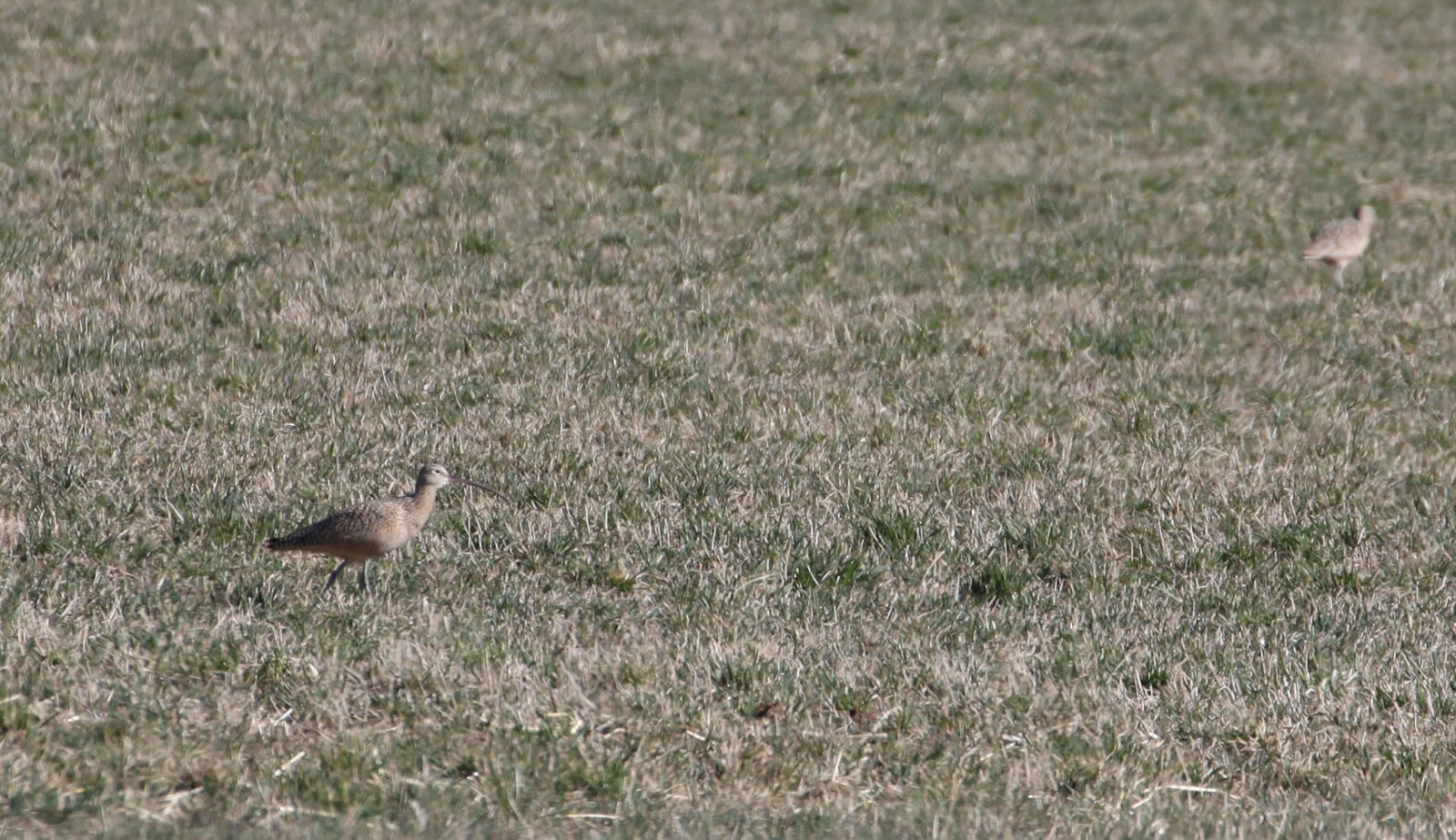
Just finished the online 21 day meditation series from Deepak Chopra and Oprah; it was great. Decided to engage the Day 17 centering thought "Through rest and play I open my creative channel". So, I spent 7 hours and driving 93 miles wildlife watching (my idea of play) today. Found 49 species of birds, the highlight being a pair of Long-billed Curlew (Numenius americanus) foraging in an ag pasture (they gave their ethereal song/call on a couple of occasions).

Long-billed Curlew
As the day progressed temperatures got to about 67 degrees; as a consequence butterfly activity picked up. Found seven species of butterfly (six were first of the year for me); three species of tortoiseshell, three species of comma and the state butterfly, the mourning cloak. All overwinter as adults and are brilliantly colored; a rainbow palette for the drab vegetation at this time of year: 
California Tortoiseshell
Compton Tortoiseshell

Milbert's Tortoiseshell
Green Comma
Mourning Cloak
Hoary Comma


Satyr Comma


My experience seemed to unfold in 'divine order'. Yes, in the words of Deepak Chopra "all is perfect, all is well". Namaste.

Monday, March 25, 2013

1st Butterfly of the Year...over Asphalt

A Milbert's Tortoiseshell (Aglais milberti) flew past me, my first butterfly for the year, while I sat in my car at a light on a four-lane highway. What's really ironic, I was going to Blodgett Canyon, a US Forest Service property just west of Hamilton, MT, that is a trailhead into the Selway Bitterroot Wilderness...I found zero butterflies there! Wildlife watching can be like this...never know what might pop into view. Here's a photo of a flashy Milbert's:
Aglais milberti
At Blodgett Canyon did find colorful wildlife in the form of many lichen species, mostly crustose in morphology, on rock:


Unfortunately, I cannot identify them (at present at least); please enjoy for form and color. Spring is arriving, find something colorful.

Thursday, February 7, 2013

Butterfly Publication...Reminder Spring is Coming

I just bought a great book about butterflies, Butterflies of Indiana A Field Guide by Jeffrey Bleth. It is an awesome piece of work surpassing identification (a thorough treatment mixing text, photos, phenology, abundance) while including behavior, ecology, natural history, butterfly gardening and watching, host plants, etc. Chock full of information that any naturalist or butterfly watcher can profit by, especially a reminder of the spring that is coming. Yes, Bitterroot Bill called for six more weeks of winter, but Mourning Cloak (Nymphalis antiopa), the State butterfly, sightings in Montana (warm days) may be only 3 weeks away! The Montana Field Guide has the species account. Tree sap and rotting fruit are the main food sources. This serves them well; they may have the longest lifespan (10-11 months) for butterfly species...that period encompasses winter conditions! In the meantime find something great.
Mourning Cloak

Monday, November 19, 2012

'Yard' Restoration...Continues

Yesterday I seeded about 400 square feet of yard to native wildflowers, photo below. Note the sand on the soil; the process of planting requires adding small seeds to 10 cups of sand, mixing thoroughly, then distributing on bare ground. That's it!!

The rock garden seed mix was acquired from Native Ideals Seed Farm. Here's a species list of what was planted:

No doubt it won't be kool-aid; hoping it will look something like this in two years or so (another part of our 'yard'):

Now have very little to mow; I've built it and they have come...wild your yard-planting time is now!


Monday, November 5, 2012

Vote Now...for the correct Fritillary ID

Timely opportunity to practice decision-making before tomorrow's voting booth visit. This poll is wildlife-centric; help me determine the identity of five different butterflies that are from the genus Speyeria or Fritillary in general. This group of insects are difficult to identify because of variability in color/pattern within species. All the shots posted below capture the underwing which is key for identification. Any resource/reference may be used in voting. You might read a American Birding Association blog posting from Ted Floyd, that overviews the concept of species in the context of birds. It is excellent reflection as basis for decision-making here with butterflies. A multiple choice form follows the photos below...good luck.


Photo 1

Photo 2

Photo 3

Photo 4

Photo 5


Monday, October 1, 2012

Full Life...

Contained in a feed from Brain Pickings is a quote from Anais Nin (1946):
Technology associated with this blog posting may be superficial as Nin describes, but it a great medium to broadcast her message. Similarly, Fast Company has a Kaihan Krippendorff web posting about finding your work purpose/passion. So a simple message to you: "Get in the moment, find your purpose/passion, go for it, be the best you inc...create a full life" 

Here is a photo link of some butterflies doing just that:
Butterfly-'Coppers' subfamily Lycaeninae

Tuesday, September 18, 2012

Rabbitbrush...Neighborhood Butterfly Magnet

Over time I've discovered that some of the best wildlife watching may be right out the front door of your home. For sure it helps if one cultivates plants/habitats attractive to wildlife around the home site. Plus, many residential areas/subdivisions may have areas that are dedicated as "parks" in the neighborhood. That's the case where I live. It just so happens the parks (not huge in size...largest about 7 home lots in extant) here have a good native component. To my discovery, the 'beat down' looking shrubs growing in these areas, Rabbitbrush (Ericameria genus) are major butterfly attractants in late summer/early fall. Paul Opler, dean of butterfly watchers, published a paper detailed 33 species of butterfly using Rabbitbrush [Journal of the Lepidopterists' Society 49 (1), 1995, 1-5]  Yes, I've been going to a large expanse of Rabbitbrush southeast of Stevensville which has been great for butterflying. However, the wildlfire smoke has been really bad there recently. So, I checked out instead the Rabbitbrush in my neighborhood parks. And I'm not talking about extensive stands, instead scattered specimens far apart that may get to 6 foot in diameter (most much smaller). Had some great action. Found west coast lady, hoary comma, juba skipper, red admiral, and clouded sulphur in an hour. Here's the video followed by photos for your enjoyment:

Clouded Sulphur

Hoary Comma

Juba Skipper

Red  Admiral

West Coast Lady