Already 13 years ago David Niven published 100 Simple Secrets of Happy People in which he distilled happiness research into "easy-to-digest nuggets of advice". I especially like Advice #92 Know What Makes You Happy or Sad; a Professor Hamler is quoted: "All science is noticing patterns". Patterns come into play when something goes really right or wrong; hopefully you have been paying attention and you realize what happened wasn't random, there was a cause and effect. Niven's take: "People feel worse if they are unhappy but have no idea why."
Studying patterns in 12,000 diary entries from corporate employees led Teresa Amabile and Steven Kramer to write a book titled The Progress Principle Using Small Wins to Ignite Joy, Engagement, and Creativity at Work. The authors discovered that small events (basically progress towards a goal or objective) can "trigger big reactions". They cited additional research that found participation in small, regular events (e.g. working out or church attendance) could yield cumulative increases in happiness. To the authors, this reflects on the "inner work life" of a person, their definition: "the confluence of perceptions, emotions, and motivations that individuals experience as they react to and make sense of the events of their workday". They further tease out that just "making progress" on a project or goal doesn't mean it will lead to a good inner work life. The work you do must be "meaningful". Work is meaningful if "you perceive your work as contributing value to something or someone who matters (even your team, yourself, or your family)". Bottom line: employing a checklist or a journal (so you can measure incremental progress) while doing meaningful work ignites joy, engagement and creativity. Amabile and Kramer employ video game playing as an example; you become addicted playing these games because the designers employ a) constant progress indicators and b) achievement markers.
And no, I haven't purposely and knowingly been applying this wisdom for a decade; I just discovered this. It's powerful. I know there have been times when I have discounted (sometimes using stronger terms) "listing" by birders. Now I discover that listing is good (at least on one level) for your joy, engagement and creativity. Below is some of my meaningful work...a video documenting my listing of two uncommon species of dragonflies (Lake Darner and Subarctic Darner) heretofore not seen before September 2013 (I believe my 7th try)! May your patterns and progress intersect with...what floats your wildlife boat :-)
Sunday, November 10, 2013


Monday, October 28, 2013
Orange Butterflies...Not Halloween Scary to Us, But...
Most of us know that Monarch butterflies (Danaus plexippus) are "toxic/unpalatable" to birds because of chemicals their larval stage ingest from milkweed plants. These butterflies exhibit warning coloration in the form of bold orange and black striping; this mechanism is referred to as "aposematism". This term was coined by W.B. Poulter in 1890 in his book The Color of Animals. Aposematism isn't just about color; it can also be about smell (think skunk).
Dennis Hoffman in his Your Sensory Desktop essay in This Will Make You Smarter (edited by John Bronkman, Harper Perennial 2012) states: "Our perceptions are neither true nor false. Instead, our perception of space and time and objects-the fragrance of a rose, the tartness of a lemon-are all part of our "sensory desktop", which functions much like a computer desktop...A graphical desktop is a guide to adaptive behavior...The graphical desktop guides useful behavior and hides what is true but not useful...Grasping the distinction between utility and truth is therefore critical to understanding a major force that shapes our bodies, minds, and sensory experiences...This leads to the concept of a sensory desktop. Our sensory experiences-such as vision, sound, taste, and touch-can be thought of as sensory desktops that have evolved to guide adaptive behavior, not report objective truths...Space, time, and objects might just be aspects of a sensory desktop specific to Homo sapiens. They might not be deep insights into objective truths, just convenient conventions that have evolved to allow us to survive in our niche. Our desktop is just our desktop."
So for your sensory desktop, below are a series of orange-colored butterflies. Some are truly "toxic/unpalatable", like the Viceroy (Limenitis archippus...absorbs chemicals from willow) and Western checkerspot species (genus Euphydryas...feed on plants of the Figwort family). Surprisingly, the literature (a cursory search of Google Scholar) doesn't have a lot of material on the spectrum of butterflies (are all butterflies somewhat "toxic/unpalatable" ?) i.e. specific species being truly aposematic or mimics. Find something good :-)
 |
| Colon Checkerspot (Euphydryas colon) |
 |
| Northern Checkerspot (Chlosyne palla) |
 |
| Viceroy (Limenitis archippus) |
 |
| Edith's Checkerspot (Euphydryas editha) |
Monday, October 14, 2013
Bumping Up Quality of Blog/Social Media Content...Attended YouTube Creator Academy
I recently finished all the requirements for a MOOC (massive open online course) from the YouTube Creator Academy. It was a very good experience on many levels. Visuals/multimedia are especially important when blogging about wildlife...this course provided me with the big picture knowledge to qualitatively improve my YouTube Channel "Filmy Nest".
YouTube stats indicate that YouTube video traffic is not coming from Blogger sites (a relatively small percentage) so the opposite is probably true (my take). Of course this means I will continue and more likely increase video content (higher quality, of course :-) of this blog...who doesn't want more readership? This is only logical because my stated mission is to inspire/motivate people to participate in wildlife...here's my latest video for experiencing living fall colors via dragonfly watching:
Thanks for visiting and find some time to do some "it's a great day" wildlife watching.
Tuesday, September 24, 2013
Evolving Skills and Equipment Wildlife Watching
 |
| Photographing Mountain Emerald (end of red arrow) |
 |
| Dot-tailed Whiteface (Leucorrhinia initacta) |
 |
| American Emerald |
Monday, September 23, 2013
Solar Power...Necessary for Late Season Dragonfly Watching
 |
| Autumn Meadowhawk |
 |
| Shadow Darner (female) |
 |
| Shadow Darner (male in flight) |
Wednesday, September 11, 2013
Contributing to the Cost of the Journey...
Talented thinkers/writers have touched on contributing to the journey. I highlighted Robert Fulghum on this theme in a previous blog post and took a small action today...I bought two Migratory Bird Hunting and Conservation Stamps.
 I'm into wildlife and believe conserving the natural resources that shaped Americans and this country is a great investment for future generations. Here's a stamp buying testimonial from Cornell Lab of Ornithology at their AllAboutBirds Blog. If you look at wildlife as "living art" as I do, do not forget to mark the date September 27 & 28 for watching a stream of the judging of this years Federal Duck Stamp entries at Maumee Bay State Park, Oregon, Ohio. Thanks for your consideration.

Tuesday, September 3, 2013
Wading for Dragonflies...Not Required, but Still Fun
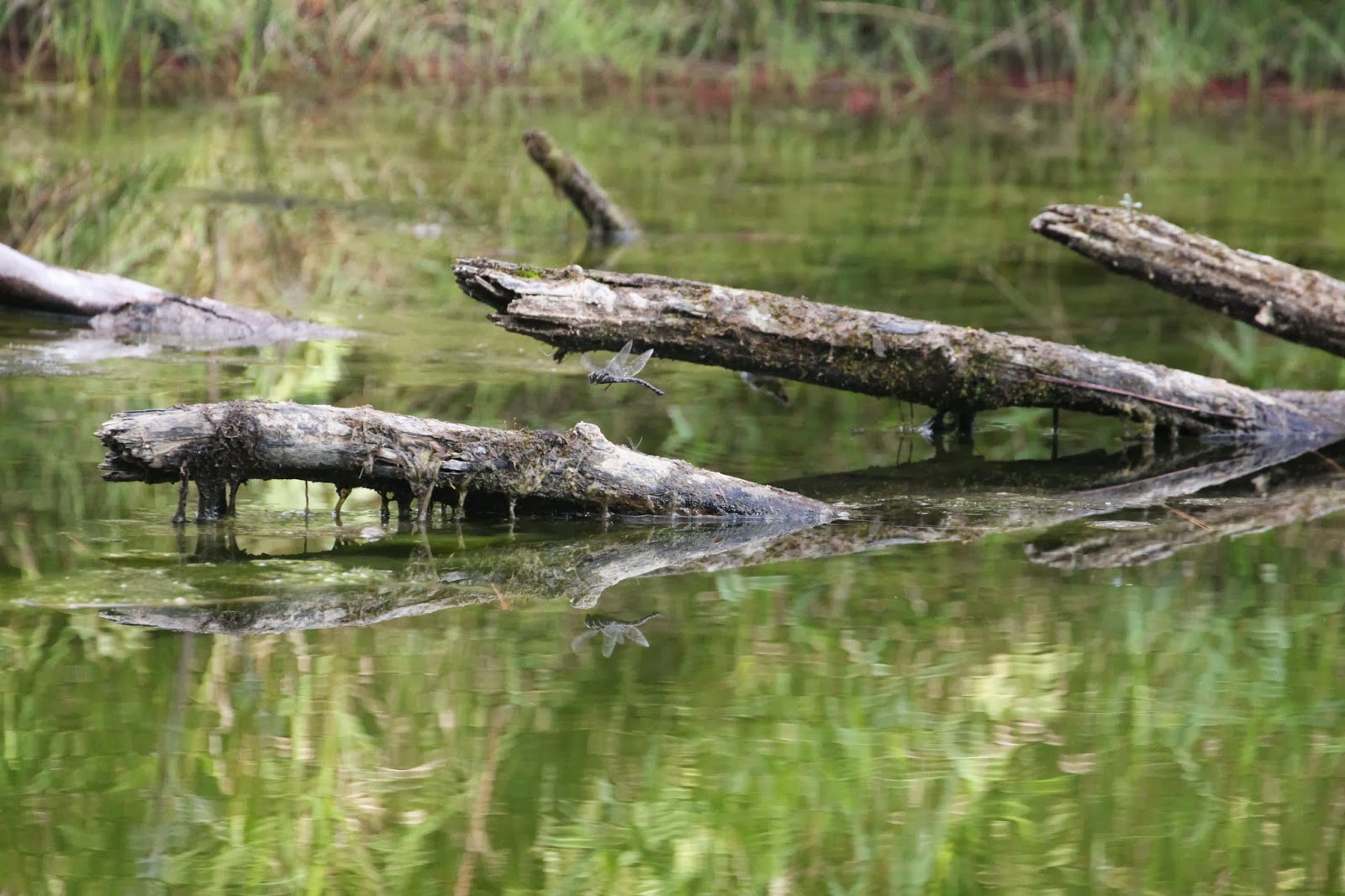
Still learning about dragonflies; however have come a long way since my last dragonfly-centric post Watching Dragonflies...Learning How. My Flickr site is my visual checklist for species I've found/identified. Made a quick trip this afternoon to Chief Looking Glass Fishing Access Site/Campground (Florence, MT) to photograph Shadow Darner (Aeshna umbrosa)...simply want a better quality photo to post online. So, this dragonfly, true to its name likes shadowy areas, especially the Bitterroot River "braids" that have slower moving water...Chief Looking Glass has been a reliable spot. Brought along the Nexus 7 along with my Canon DSLR to capture the action.
Clouds and rain cut my adventure down to about fifteen minutes but, in that time found, photographed and video'd a female Paddle-tailed Darner (Aeshna palmata) laying eggs in the river bottom. Dennis Paulson has authored two excellent field guides to assist/mentor you in your wildlife watching of these ephemeral, colorful animals. There is still enough summer to find some dragonflies near your home...go out and find something good!
Clouds and rain cut my adventure down to about fifteen minutes but, in that time found, photographed and video'd a female Paddle-tailed Darner (Aeshna palmata) laying eggs in the river bottom. Dennis Paulson has authored two excellent field guides to assist/mentor you in your wildlife watching of these ephemeral, colorful animals. There is still enough summer to find some dragonflies near your home...go out and find something good!
Subscribe to:
Posts (Atom)