Showing posts with label Darner. Show all posts

Sunday, August 30, 2015

“Hanging Up”...Not the Phone or Your Clothing

In dragonfly parlance “hanging up” is a phrasal verb describing perching behavior of certain species of dragonflies; the term defines a dragonfly species clinging to vegetation in a vertical manner. So, what is the big deal? Well, if you want to identify or photograph a certain species, finding said species hanging up might be the best/only opportunity. Why?  Some dragonflies fly almost constantly and they are referred to as “fliers” (duh:-)

The 41 species of the Darner family (Aeshnidae) are notorious fliers. How often do they hang up? No pattern or cycle has been identified or published, it seems to be all random. Now imagine trying to find a two to three and a half inch long dragonfly, using a mental search image, hanging from a leaf, branch, snag from ground level to tree top. Mission unlikely unless you see one hang up in real time. Following a dragonfly in flight is tricky; they can move in any of six ways instantly: forward, back, left, right, down and up. Even only at 34 mph, typical maximum flight speed (Wikipedia), following a dragonfly can be difficult.

Like everything else, once you do something regularly your skills, knowledge improve and actions uncover more opportunity. Your actions become quick, instinctual, a novice might describe it as magic (think identification when birding). A veteran dragonfly enthusiast from Texas, Troy Hibbitts, related a recent experience with a flier on the Texas Odes listserve:

Regal Darner would be a New County Record and westernmost record for the species here in Kinney County.  I've now seen 4 here . . .but alas no photos!

Last year, I had 3 Regal Darner fly-bys at Fort Clark Springs, two of which were at close range (once while I was driving out to the wastewater treatment ponds, and one while I was swimming at the pool). No real photo opportunities last year.

Today, while my wife and I were running trails, I flushed a large darner.  I was in front, and going slowly enough that I was able to stop and watch it hang back up.  Boom! Regal Darner at close range, hung up!  Dagnabit!  Camera 2 miles away at home!  So we edged carefully around it, and left it hanging up.  It never once moved.  I'd estimate the run back to the truck at 5 minutes, 10 minutes to drive back to the house, grab the camera, and drive back.  Got back.  Still hanging.  Still at a distance, it noticed me, rocked once.  I should have taken the obscured by branches "safe" shot.  Stupidly, I did not.  Took half step to right to get the unobstructed "safe" shot.  It flew off its perched, right over my head, thought about hanging up right there, then wheeled back out over the trail and flew up into the canopy!!! 

Troy’s wonderful, dramatic story highlights the upside and downside challenge of “doing” dragonflies. By the way, this has happened to me just not on the same scale. Have been lucky lately. Photographed two Paddle-tailed Darners (Aeshna palmata below) hung up on the same day (first for me), one found by search image (low in grass) and the other in real time (20 foot up in cottonwood).

I encourage you to hang around at your favorite nature hang out, perhaps you will hang with some cooperative dragonfly species. Just don’t get hung up on instant success...the fun is in the long-term doing :-)

Paddle-tailed Darner

Paddle-tailed Darner

Sunday, November 10, 2013

Science of Happiness Applied to Wildlife Watching...Patterns and Progress

Already 13 years ago David Niven published 100 Simple Secrets of Happy People in which he distilled happiness research into "easy-to-digest nuggets of advice". I especially like Advice #92 Know What Makes You Happy or Sad; a Professor Hamler is quoted: "All science is noticing patterns". Patterns come into play when something goes really right or wrong; hopefully you have been paying attention and you realize what happened wasn't random, there was a cause and effect. Niven's take: "People feel worse if they are unhappy but have no idea why."

Studying patterns in 12,000 diary entries from corporate employees led Teresa Amabile and Steven Kramer to write a book titled The Progress Principle Using Small Wins to Ignite Joy, Engagement, and Creativity at Work. The authors discovered that small events (basically progress towards a goal or objective) can "trigger big reactions". They cited additional research that found participation in small, regular events (e.g. working out or church attendance) could yield cumulative increases in happiness. To the authors, this reflects on the "inner work life" of a person, their definition: "the confluence of perceptions, emotions, and motivations that individuals experience as they react to and make sense of the events of their workday". They further tease out that just "making progress" on a project or goal doesn't mean it will lead to a good inner work life. The work you do must be "meaningful". Work is meaningful if "you perceive your work as contributing value to something or someone who matters (even your team, yourself, or your family)". Bottom line: employing a checklist or a journal (so you can measure incremental progress) while doing meaningful work ignites joy, engagement and creativity. Amabile and Kramer employ video game playing as an example; you become addicted playing these games because the designers employ a) constant progress indicators and b) achievement markers.

And no, I haven't purposely and knowingly been applying this wisdom for a decade; I just discovered this. It's powerful. I know there have been times when I have discounted (sometimes using stronger terms) "listing" by birders. Now I discover that listing is good (at least on one level) for your joy, engagement and creativity. Below is some of my meaningful work...a video documenting my listing of two uncommon species of dragonflies (Lake Darner and Subarctic Darner) heretofore not seen before September 2013 (I believe my 7th try)! May your patterns and progress intersect with...what floats your wildlife boat :-)

Monday, September 23, 2013

Solar Power...Necessary for Late Season Dragonfly Watching

The dragonfly-watching (all bugs really) season is winding down, fewer species of lesser numbers are extant. The Bitterroot Mountain peaks have snow and daytime highs are only reaching low 60's F. Yes, time of year impacts watching these colorful insects. But, so do clouds blocking the sun in the heat of the summer; this can dramatically reduce dragonfly activity. The reverse is true in the spring/fall, solar power is the magic component for observing late season dragonflies and may be required for habitat occupancy (research). Conditions today close to acceptable, partly cloudy and about 60 F. So I made a quick trip (second time lately, visited on September 3) to Chief Looking Glass Fishing Access Site to find/photograph Shadow Darner (Aeshna umbrosa); need a good flight shot for my G+ Dragonfly-'Darner' album. Waited several minutes at arrival for large patch of blue sky to effect dragonfly activity; yep, it worked had a Autumn Meadowhawk (Sympetrum vicinum) perch on a rock in the shallow river.
Autumn Meadowhawk
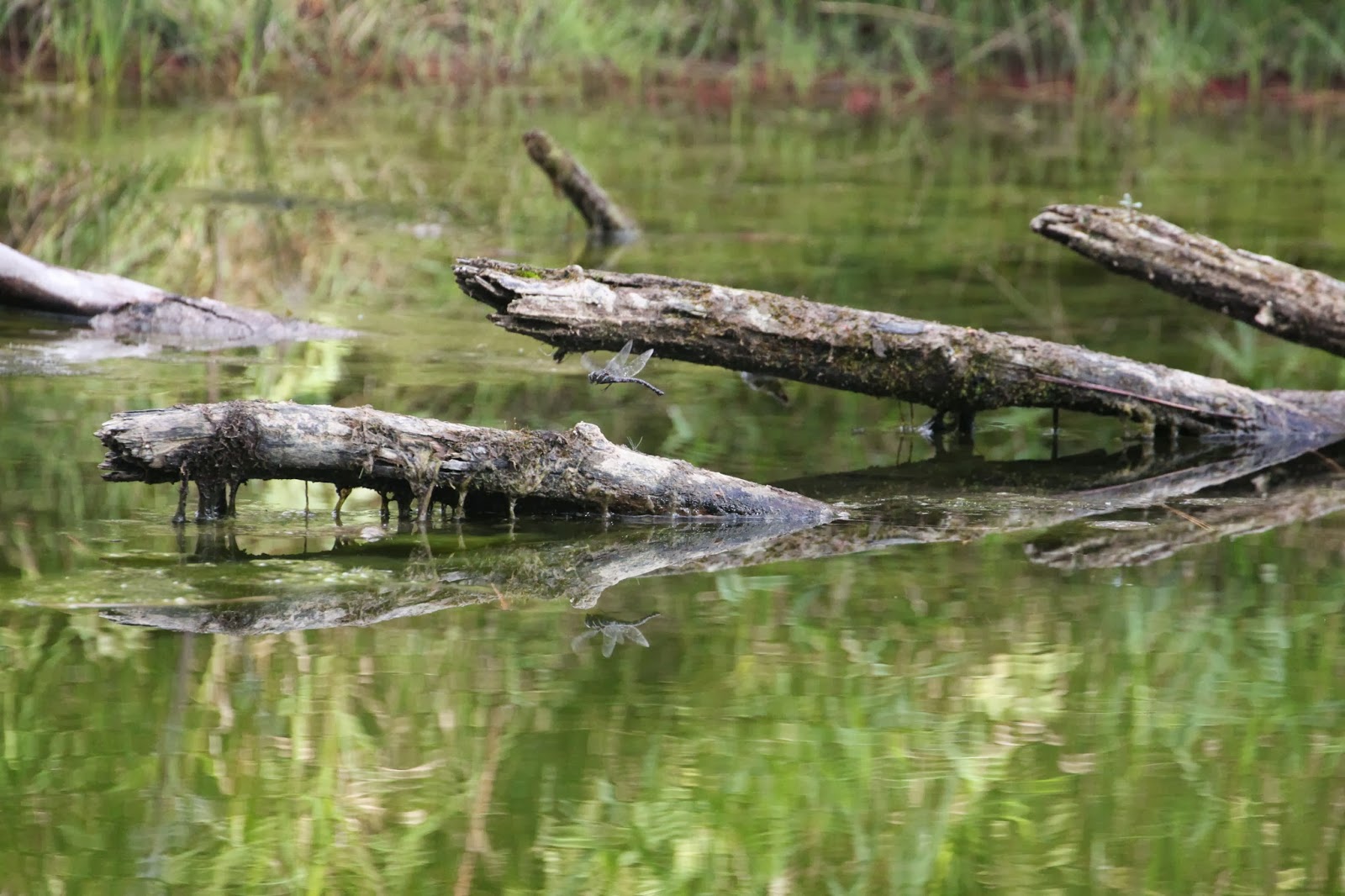
Shortly thereafter had a darner fly past about a foot above the water. Followed and got a shot of a female Shadow Darner laying eggs in or near tree branch in river. Had success in finding a male Shadow, but the resulting photo not exactly National Geographic quality. Nature and Photography website has some good advice for photographing dragonflies. I'm going to try again, maybe multiple times if we have a typical 'indian summer' this fall. Find something cool yourself.
Shadow Darner (female)
Shadow Darner (male in flight)

Tuesday, September 3, 2013

Wading for Dragonflies...Not Required, but Still Fun

Still learning about dragonflies; however have come a long way since my last dragonfly-centric post Watching Dragonflies...Learning How. My Flickr site is my visual checklist for species I've found/identified. Made a quick trip this afternoon to Chief Looking Glass Fishing Access Site/Campground (Florence, MT) to photograph Shadow Darner (Aeshna umbrosa)...simply want a better quality photo to post online. So, this dragonfly, true to its name likes shadowy areas, especially the Bitterroot River "braids" that have slower moving water...Chief Looking Glass has been a reliable spot. Brought along the Nexus 7 along with my Canon DSLR to capture the action.

Clouds and rain cut my adventure down to about fifteen minutes but, in that time found, photographed and video'd a female Paddle-tailed Darner (Aeshna palmata) laying eggs in the river bottom. Dennis Paulson has authored two excellent field guides to assist/mentor you in your wildlife watching of these ephemeral, colorful animals. There is still enough summer to find some dragonflies near your home...go out and find something good!